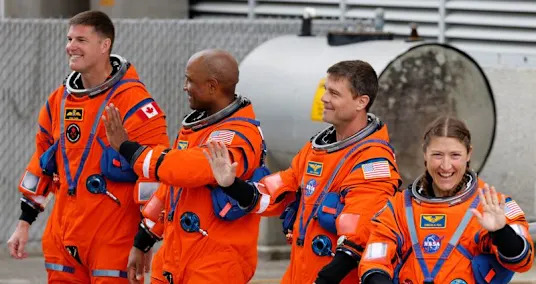
April 1 (Reuters) - All three NASA astronauts on the Artemis II lunar mission are veterans of Earth-orbit science expeditions to the International Space Station, while the lone Canadian joining them on a voyage around the moon and back is a spaceflight rookie.
Here are some highlights from the careers of mission commander Reid Wiseman, pilot Victor Glover and mission specialist Christina Koch, all U.S. astronauts, and Canadian astronaut Jeremy Hansen, also a mission specialist.
MISSION COMMANDER REID WISEMAN
Wiseman, 50, logged 165 days aboard the International Space Station during a 2014 mission, flying to the orbiting platform aboard a Russian Soyuz spacecraft. A former U.S. Navy test pilot, he later served as NASA's chief astronaut before being selected to command Artemis II.
PILOT VICTOR GLOVER
Glover, 49, spent 168 days in orbit beginning in 2020 as pilot of NASA's Crew-1 flight, the first full-fledged ISS mission using SpaceX's Crew Dragon capsule to carry astronauts to the space station. Before joining NASA, he flew more than 40 aircraft during a U.S. Navy career that included combat deployments and test-pilot duties. A veteran of four spacewalks, he is the first Black astronaut ever to be sent on a lunar mission.
MISSION SPECIALIST CHRISTINA KOCH
Koch, 47, set a record in 2019 for the longest continuous spaceflight by a woman, spending 328 days aboard the ISS, and was part of NASA's first three all-female spacewalks. Trained as an electrical engineer and physicist, she previously worked as a NASA engineer and carried out extended research expeditions in Antarctica. She is the first woman to fly on a moon-bound mission.
MISSION SPECIALIST JEREMY HANSEN
Hansen, 50, a Royal Canadian Air Force colonel, is the first Canadian, and first non-U.S. citizen, sent on a lunar mission even as he makes his own first spaceflight. He was selected for Canada's astronaut corps in 2009, and his seat aboard Artemis II reflects a long-standing U.S.–Canadian partnership in human spaceflight, including Canada's contributions to robotics used aboard the ISS.
(Compiled by Joey Roulette in Cape Canaveral, Florida and Steve Gorman in Los Angeles; Editing by Jamie Freed)
LATEST POSTS
- 1
 The Benefits of Rehearsing Careful Nurturing
 - 29 Under-The-Radar Malaysian Islands To Consider Instead Of Thailand Or Indonesia
- 3Ski Resorts Universally: A Colder time of year Wonderland Guide
- 4NASA loses contact with its Maven spacecraft orbiting Mars for the past decade
- 5‘Aid for Ukraine’ pierogi fundraiser event




- The Forgotten BMW Coupe That Turned a 5 Series Into Something Far More Exotic
- Watch interstellar comet 3I/ATLAS make its closest approach to Earth in free livestream on Dec. 18
- Italy now recognizes the crime of femicide and punishes it with life in prison
- Effectiveness Uncovered: A Survey of \Smoothing out Your Errands\ Efficiency Application
- Careful Nurturing: Techniques for Bringing up Tough Children
- German finance minister sees advantages of smartphones in schools
- New electric car registrations rise sharply in Germany in March
- Little Urban areas to Visit in Western Europe
- Syria rejects forced deportations from Germany amid migration debate