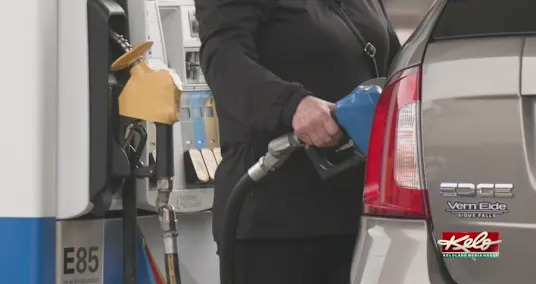
SIOUX FALLS, S.D. (KELO) – As the war with Iran continues, people here at home are feeling the impact.
Perhaps the place most of us continue to feel the impact of the war is at the gas station.
Brookings authorities: Pub Crawl exceeds Hobo Day arrests
“Gas is definitely taking up a lot more of my money that it was before,” Jacob Smith Mendez from Sioux Falls said.
And people who work in the food delivery service, like Caden Iken, might feel it even more.
“The amount of gas that you’ll get with ten dollars, twenty dollars, is a lot different than when it used to be two dollars,” Iken said. “So, I mean, that’s cutting into my profits and how much money I make and how far I can drive.”
The higher prices are due in part to the disruption of crude oil being transported through the Strait of Hormuz
“But not only that, there’s a number of different essential products out there also. And, just to put this in to context, it’s the third major supply chain disruption that we’ve been experiencing,” Evert Van der Sluis, a professor of economics at SDSU, said. “You know, we had COVID a few years ago and then we had Russia’s invasion of Ukraine. We learned from those previous two occasions that even a short blockage can really mess up the global supply chains but this may be the big one. This might be a much bigger disruption.”
And it’s unclear how long that disruption will last.
“There are some people who say that if this conflict lasts, if it drags on, then oil prices could get a lot higher,” Van der Sluis said. “And that’s not just oil prices and gasoline prices, but it’s everything else that depends on oil — transportation, you know, trying to find an airline ticket somewhere and all of that. That’s going to have a negative economic affect, no doubt.”
In the meantime, everyday Americans are doing what they can to afford the prices at the pump.
“Whatever I need, you know, right now I’m at half a tank so I just put ten dollars in, get me around the city, get me to the job,” Smith Mendez said.
Farmers are also feeling the impact of the war with disruptions in fertilizer also coming through the Strait of Hormuz.
Van der Sluis went much more in-depth with us about the impacts the war is having on the economy and consumer spending. You can catch more of that conversation this Thursday at 6:30 during Your Money Matters More on KELOLAND Plus.
If you’d like to track the gas prices in your area, click here.
Copyright 2026 Nexstar Media, Inc. All rights reserved. This material may not be published, broadcast, rewritten, or redistributed.
For the latest news, weather, sports, and streaming video, head to KELOLAND.com.
LATEST POSTS
- 1
 These 2 moon rovers used cameras and lasers to hunt for simulated water ice — and one looks like WALL-E
- 2Independence from the rat race for Recent college grads: Systems and Tips
- 3Germany to create restitution council to return colonia-era acquired cultural artefacts
- 4Embrace Effortlessness: Moderation and Cleaning up Tips
- 5When a sperm whale gives birth, the mother gets help from her friends




- Manhunt for Brown University shooter continues: FBI releases photos of suspect, announces $50K reward
- Germany sees third consecutive diesel price record after rule change
- Find the Mysteries of Powerful Using time productively: Augmenting Efficiency and Proficiency
- New science points to 4 distinct types of autism
- This Tiny Bright Yellow Frog Is One of the Most Toxic Animals on Earth
- The Best Web-based Courses for Ability Advancement
- Humpback whale stranded on Germany's Baltic coast frees itself
- The many ways that baking is winter therapy. With a delicious ending
- What is Fusarium graminearum, the fungus a Chinese scientist pleaded guilty to smuggling into the US?